World action model security · Visual patch attack
Attacking Action-Facing
Visual Routes
PASA-KV investigates how a small RGB patch can disrupt the visual key/value routes used by robot actions in world action models (WAM)





Abstract
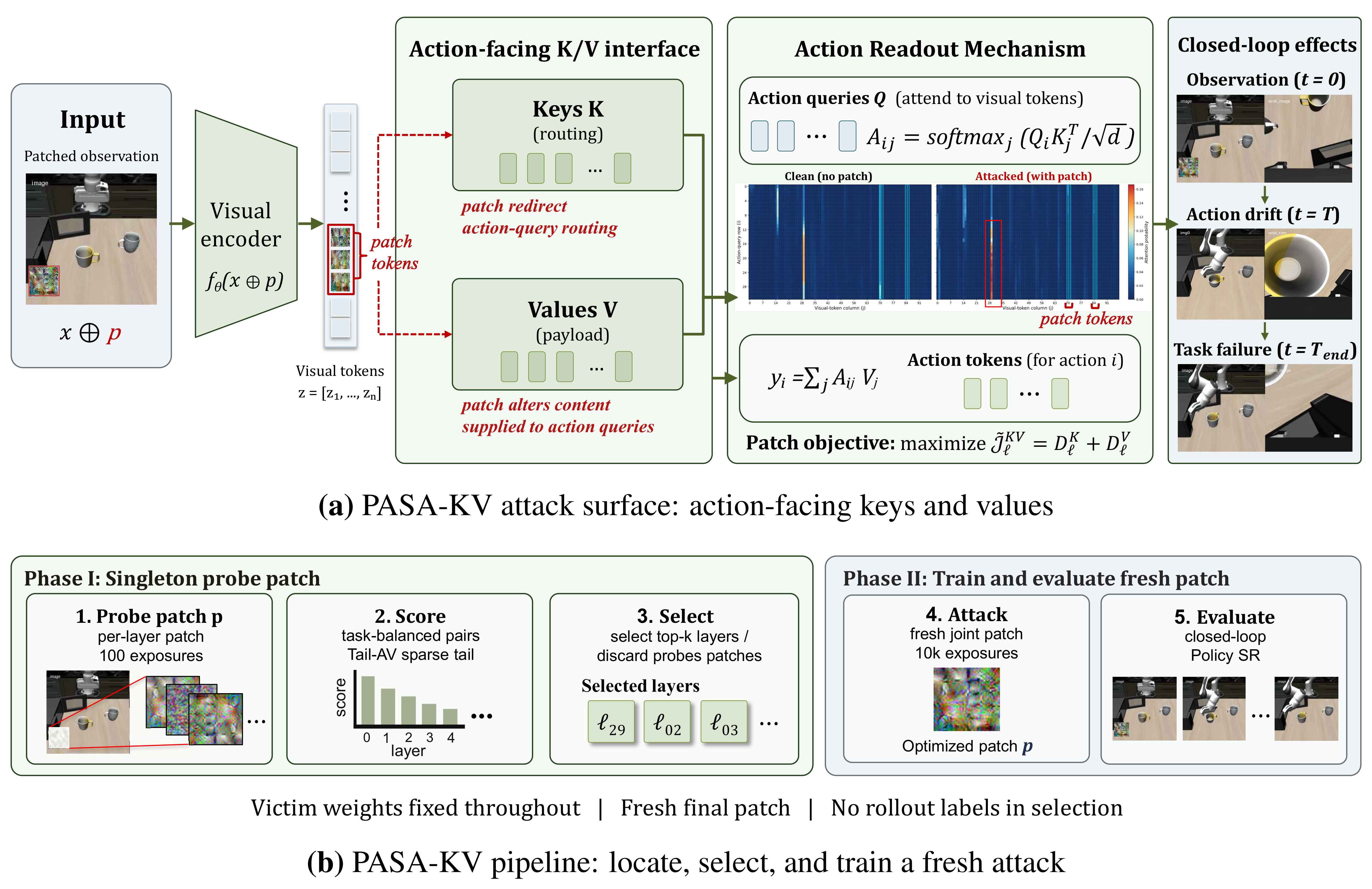
PASA-KV is a white box visual patch attack on world action models. It first uses short probes to identify visual key/value routes that influence action readouts, then selects layers with Tail-AV on held-out clean and patched observations. A fresh RGB patch is trained against the selected routes while the model remains frozen. We evaluate the attack through closed loop policy success in simulation and on a real robot.
Method
The optimized object is an RGB patch on camera pixels. Visual keys affect where action queries read; visual values carry the content they receive
Simulation results
Policy success rate measures completed tasks under closed loop evaluation. Lower success under attack indicates a stronger effect
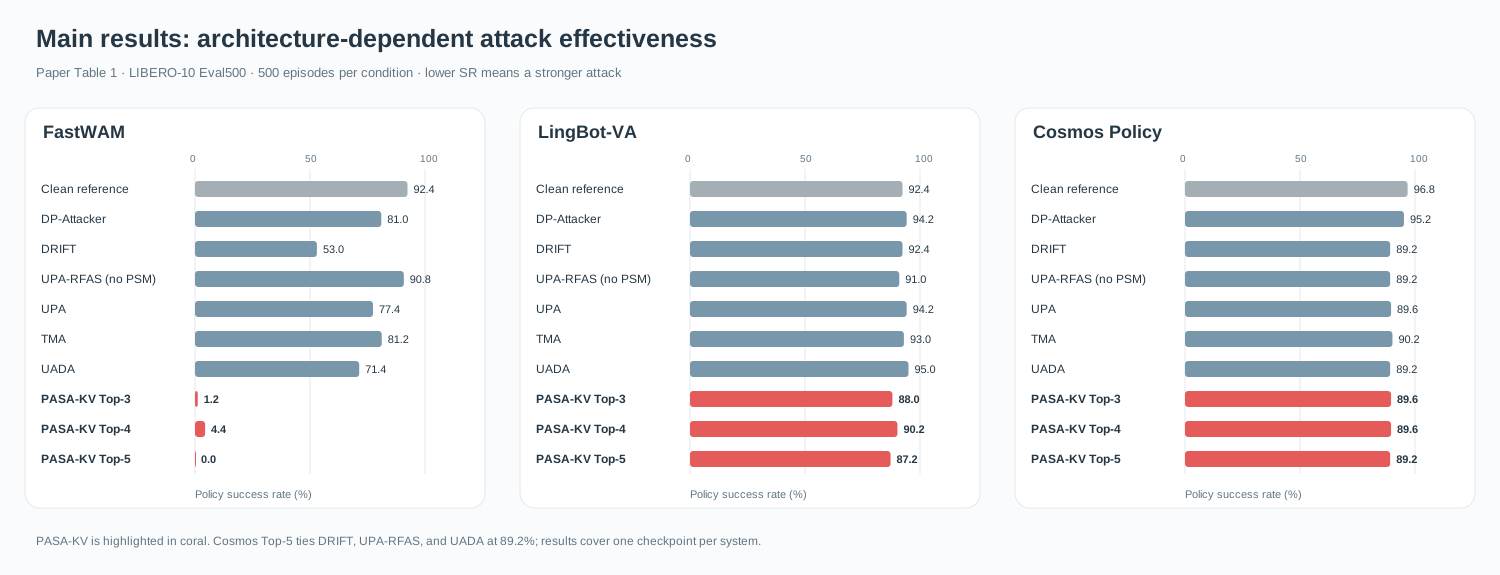
FastWAM · Eval500 Clean policy success was 92.4%; PASA-KV Top-5 reduced it to 0.0% across 500 evaluation episodes
Layer selection · Eval200 Tail-AV selected layers yielded 1.5% policy success, compared with 47.5% when layers were selected by probe K/V displacement under matched conditions
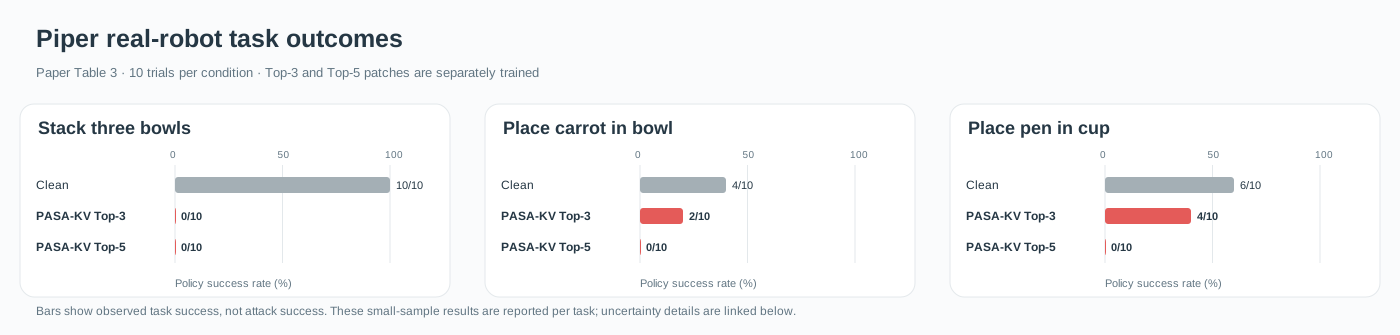
Real robot evaluation
Piper robot demonstrations from clean and PASA-KV Top-5 conditions, shown at 5× speed